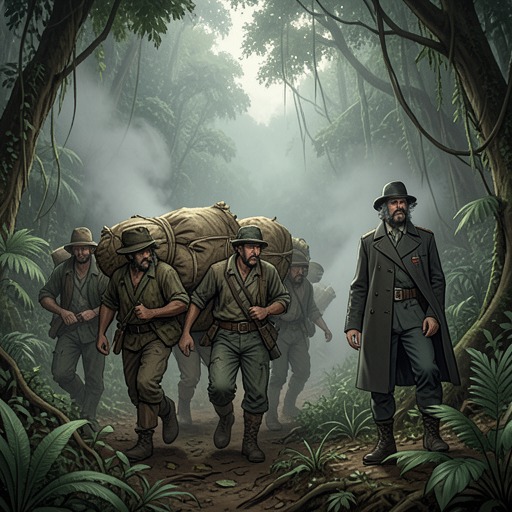
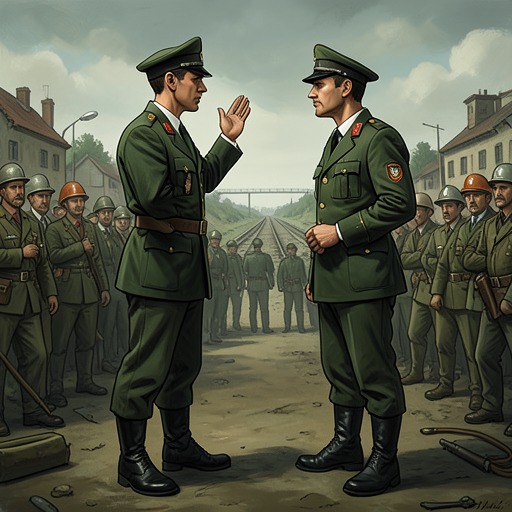
Dorrigo negotiates with Nakamura over the number of POW laborers
The Narrow Road to the Deep NorthDorrigo Evans’s negotiation with Major Nakamura over the number of POW laborers exposes the central cruelty of the railway camp: men are counted as a workforce even when illness has left them unfit to work. At a rain-soaked assembly, Dorrigo uses his authority as commanding officer and senior medical officer to argue for a lower quota. Nakamura insists that the railway must receive its required laborers. Their bargain ends at 429 men, a figure Dorrigo accepts knowing that the arithmetic cannot make the work safe.
Setting and Stakes
The negotiation takes place during a prisoner assembly in the rain. The Japanese officers wait inside the administration hut until the worst of the downpour passes. Lieutenant Fukuhara oversees the selection; Major Nakamura, in a bedraggled uniform, joins him. As the prisoners are counted, each man must call out his Japanese number. The procedure turns the camp’s diminishing population into an official tally, even as deaths and sickness make that tally increasingly difficult to translate into labor.
Dorrigo reports that four men died the previous day and two more overnight, leaving 838 POWs. Of these, 67 have cholera and are in the cholera compound; 179 are hospitalized with serious illness; another 167 can manage only light duties; and 62 more report sick that morning. Dorrigo calculates that 363 men remain for railway work. These categories are not abstractions to him: they determine which sick men may be sent out and which might be allowed to recover. The Japanese demand, by contrast, is set by the work the railway requires.
The Quota Dispute
Nakamura demands 500 prisoners. Fukuhara conveys the order, while Dorrigo replies that there are not 500 fit men and that cholera is spreading through the camp. Fukuhara counters that the Australians would avoid cholera if they washed like Japanese soldiers. Dorrigo knows that the camp has no baths and no time to heat water; the remark offers no practical answer to the outbreak or the shortage of healthy workers.
The demand does not ease. Dorrigo has expected the quota to settle near 380, following earlier negotiations, but now the camp has more sick men and fewer available workers. When Nakamura presses for men from the hospital, Dorrigo refuses to treat the sick as fit for labor. He proposes 400 instead, describing the men’s conditions and arguing that sending more would kill men who might be useful once they had recovered. He understands, however, that medical judgment offers little protection against a demand made in the name of the railway.
The Sick Man and the Bargain
Nakamura calls for a prisoner to be brought forward. One man cannot remain standing. Dorrigo recognizes that he is severely ill, kneels beside him, and lifts him, insisting that he is too sick to work. Nakamura strikes Dorrigo while he holds the man. Dorrigo concentrates on keeping his balance and not dropping him; the scene makes the dispute’s stakes immediate. The number under negotiation is not a theoretical quota but a decision about whether this particular prisoner will be counted as labor.
Dorrigo revises his figure to 399 after excluding the man he is carrying. He knows that neither 363 nor 399 describes the true condition of the camp: all the prisoners are suffering from hunger and illness, and none is fit for what the Japanese expect. Still, he tries to calculate a maximum by identifying the least sick men, including some who might be moved from hospital to very light duties and others who might then be sent to work. His estimate reaches 406, but he expects Nakamura to demand more.
Nakamura names 430 and refuses to yield. The two men pause in a silent exchange of looks: Nakamura’s determination to prevail meets Dorrigo’s refusal to submit. The bargaining resumes, with the Emperor’s will invoked as the authority behind the railway order. Dorrigo answers that he knows, then settles at 429. The deal is done, and the day’s work begins. He cannot tell whether he has won or lost; he knows only that each compromise leaves more men exposed to the work and that its cost will be counted in lives.
Significance
The encounter shows Dorrigo’s command as an exercise in constrained care. His medical role gives him information with which to argue, but no power to cancel the labor demand. He must distinguish among degrees of illness and make a practical selection from a population in which, by his own reckoning, no one is truly fit. Negotiation can reduce the number demanded, but it cannot remove the coercive system that makes the demand.
The sequence also contrasts two kinds of accounting. The Japanese count the laborers needed to build the railway; Dorrigo counts the sick, the dead, and those least likely to die if sent out. His final figure of 429 is neither a victory nor a neutral compromise. It marks the point where his limited ability to protect the prisoners meets an order he cannot overturn. The episode makes visible how the railway’s quota converts medical judgment into a daily calculation of risk.